

Registered Trustees · Diani Beach, Kenya
The House ofDe Bellotte
One name, carried from the Balanta lands across Grenada to the Kenyan coast, and onward to the generations still to come.
Chapter One
A house is not a building.It is a memory kept.
What the family holds is older than any of its property. It is a record, letters preserved, portraits named on the reverse, unions witnessed, children entered into the registry in the year of their birth.
The House of De Bellotte exists to keep that record intact, and to make certain that a descendant born a century from now can still trace the line back to its beginning without a single link missing.
The Arms
Granted by theKenyan College of Arms

Registered pursuant to section 6(1) of the College of Arms Act, Republic of Kenya.
Strength · Diversity
Motto, Sable on a ribbon Argent
The Blazon
Quarterly, first and fourth Argent, a handshake Proper; second, a pharaonic knot Sable over a field Tenne; third, a modern hovel on a field Argent, and a balance Sable; fourth, a similitude of the Kenya flag, all within a bordure quarterly of the second and fourth. Dexter base, a lion couped; sinister, a cluster of four towers above a feather.
The Handshake
First and fourth: Argent, a handshake Proper
Kinship and covenant. The first and fourth quarters, the strongest positions on the shield, are given to the agreement between one member of the family and another.
The Pharaonic Knot
Second: a pharaonic knot Sable over a field Tenne
The Balanta origin, in the lands bordering Egypt and Sudan. An endless knot has no beginning and no end, a line that cannot be cut.
Dwelling & Balance
Third: a modern hovel on a field Argent, and a balance Sable
The household and the scales together, the family's affairs weighed fairly, and shelter given before it is asked for.
The Kenyan Colours
Fourth: a similitude of the Kenya flag, within a bordure quarterly
The country that received the family and granted its arms, borne in the quarter of the present generation.
Lion & City
Dexter base, a lion couped; sinister, four towers above a feather
Courage on one side; on the other the work of the living family, the city built, and the feather of the record kept.
Baobab & Open Books
Crest: on a wreath Or, a baobab tree Proper, flanked by two figures each holding an open book
The tree that outlives generations, attended by learning. The name is kept by those who read it and write it down.
Supporters
Two spears Sable
In chief, dexter and sinister, the House defends its own.
Two corn stalks Or
Sustenance, and the obligation to provide it.
Nutmegs Or, in base dexter
Grenada, the island of the crossing.
Coconut Or, in base sinister
The East African coast, where the House keeps its seat.
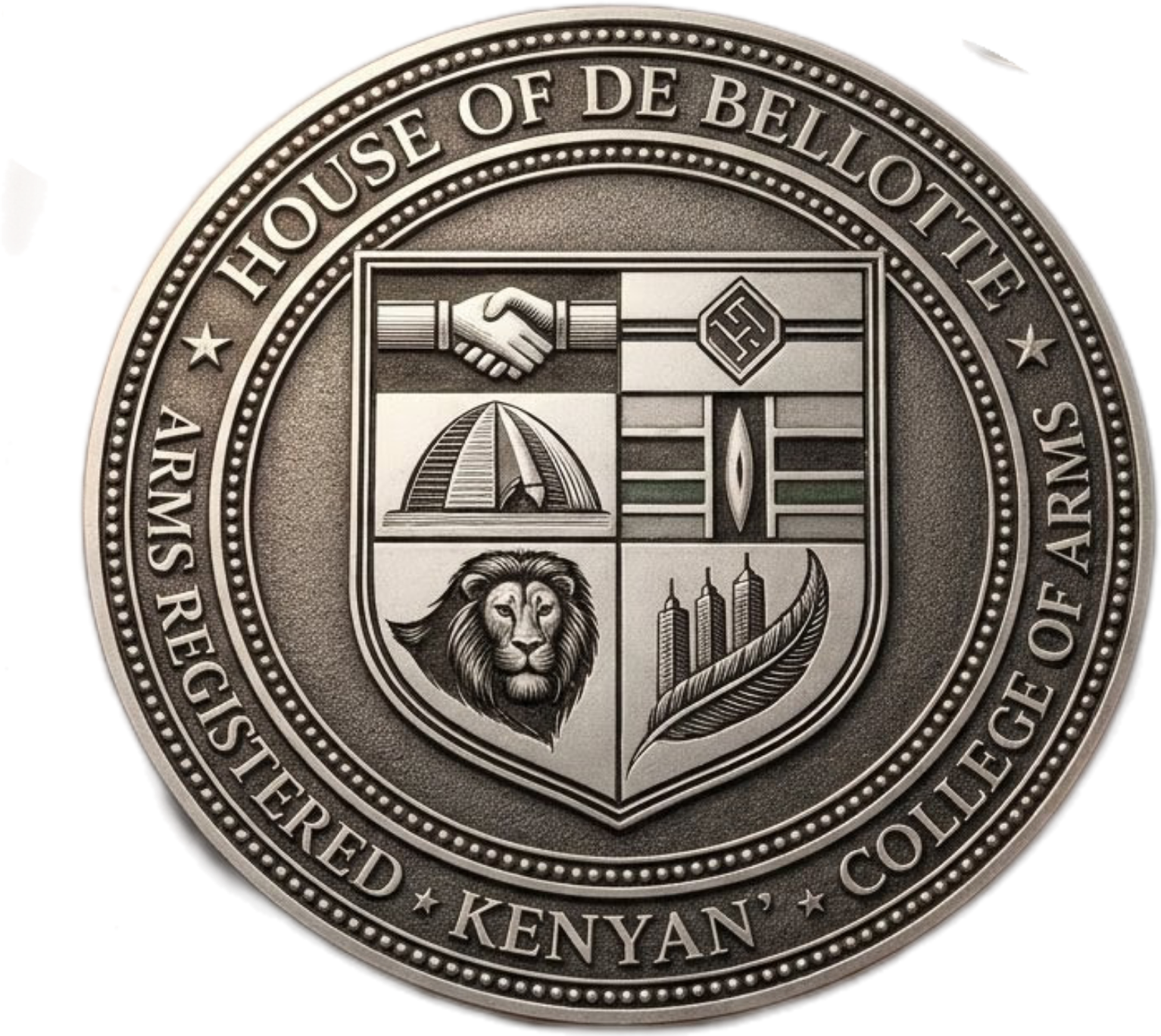
The medallion was struck by the founder, bearing the same shield within the legend of the House.

Chapter Two
The Lineage
I
Founder and Patriarch
John Morris De Bellotte
The founder and living head of the JM Lineage. From him the House takes its bearing, its arms, its seat in Kenya, and the registry that records every name that follows.
II
Second Generation
The True Born Heir
Through the heir, the name continues. One direct descendant carries the line forward, and upon this succession the future branches of the House will be established.
III
Future Generation
Branches to Come
The households and descendants not yet recorded, whose names will be entered into the registry as the line extends into its next chapters.
IV
Generations Yet Unborn
The House Eternal
The name is held in trust for those who will inherit it. The duty of each generation is to pass it on intact, honourable, and undiminished.
The registry of names is held privately by the House and is available to acknowledged members.
Chapter Three
AncestralResearch
The House traces its history through three distinct paths: a genetically confirmed Brassa-Balanta paternal line, its documented Grenadian lineage, and a possible French connection through the historic Bellot family of Blayais. Each path is recorded according to the evidence supporting it.
The Brassa-Balanta Paternal Line
African Ancestry completed a PatriClan analysis for John DeBellotte on 16 September 2021. The resulting Certificate of Ancestry states:
"John DeBellotte shares paternal genetic ancestry with Balanta people living in Guinea-Bissau."
The PatriClan analysis examines Y-chromosome markers inherited through the direct father-to-son line. This result identifies the founder's paternal genetic ancestry and extends to descendants who share the same uninterrupted male line.
The people widely known as Balanta call themselves Brassa or Brassé. Their modern homeland lies primarily in Guinea-Bissau, with communities in Senegal and The Gambia.
Brassa oral history traces an ancient westward migration from the Nile Valley, including areas associated with present-day Egypt, Sudan, and Ethiopia.
In West Africa, the Brassa developed strong martial and defensive traditions. They resisted Mandinka expansion, slave-raiding, and outside control. This resistance gave rise to the Mandinka name Balanta, commonly translated as "those who resist."
The House recognizes its Brassa-Balanta connection as confirmed paternal genetic ancestry. The Nile Valley migration is preserved as the ancestral history of the Brassa people and remains a subject of continuing historical and genetic study.
The Grenadian Line
John Norbert DeBellotte was born in Grenada on 4 December 1943. He was the son of Anna May DeBellotte and James Arthur Best.
Family history places Anna May and earlier DeBellotte generations in Grenada. It also records her later life and death in Trinidad.
Before his death in 2025, John Norbert told his son, John Morris De Bellotte, about two relatives remembered as Edwin or Edwy and Edred. Their full names, relationships, dates, and places of residence remain under investigation.
John Norbert later immigrated to the United States. His son, John Morris De Bellotte, was born in Reading, Pennsylvania, in 1982.
John Morris moved from Pennsylvania to Kenya in 2019. He later established the Kenyan-based House of De Bellotte and the JM Lineage, seated in Diani Beach.
The House is examining Grenadian parish registers, civil records, land deeds, family papers, Trinidad records, and oral testimony to identify the generations preceding Anna May DeBellotte.
The French Record
French archival records document the Bellot family in possession of Château de Ségonzac in Blayais by 1666.
Robert Bellot, Écuyer and Lord of Marchais and Ségonzac, registered the family shield in the Armorial général de France in 1696.
The historic shield bears a gold field with two red lions facing each other beneath a blue chief bearing three silver stars.
French and Québec records identify Charles-Joseph de Bellot, born in Québec on 17 August 1764, as a member of the Ségonzac family. He was the son of Joseph-Antoine de Bellot and Charlotte-Marguerite de Ramezay.
The House is investigating whether Charles-Joseph was connected to Charles de Bellot later associated with Grenada and whether the Grenadian De Bellotte line descends from this family.
No documentary record currently connects Anna May DeBellotte or her known Grenadian ancestors to the Ségonzac family.
Standards of Recognition
The House recognizes its Brassa-Balanta paternal ancestry through genetic evidence and its Grenadian lineage through civil records, family records, and oral history.
The House will recognize the French connection only after documentary evidence links the Grenadian line to the Ségonzac family.
The official arms of the House of De Bellotte are those granted to John Morris De Bellotte and registered by the College of Arms of Kenya under reference COA-9G7TW.
The historic Bellot shield appears only as an archival reference. It does not form part of the Kenyan grant.
Chapter Four
The Housekeeps its own counsel
Like the old houses of Europe, the House of De Bellotte does not publish its private arrangements. What holds it together is passed down with the name itself: a regard for the seat, the line, and the duty owed to those who come after.
- 01
The Seat
The House keeps its seat in Diani Beach, Kenya, where the line has made its home and where the family's records are held.
- 02
The Line
The name passes from one generation to the next through the true-born heirs. Their number may grow with the line, but each inherits a duty of care, not a possession.
- 03
The Name
The name De Bellotte is rare, fewer than a thousand bear it worldwide, yet not every De Bellotte belongs to this line. Some spell it without the space, some without the final e. Membership therefore requires more than the name: a progenitor of the House must publicly claim the child before their eighteenth year.
- 04
The Legacy
Each generation holds the legacy in trust for the next, so that the line continues intact, honourable, and undiminished.
Chapter Five
What the Housegives away
The House directs its giving narrowly, and keeps to it: the discipline of the body, the care of the living, and the science that will serve those who come after.
01
Martial Arts
The disciplines of the body and the temper. The House supports instruction that teaches restraint before force, and carries that teaching to young people who would not otherwise receive it.
02
Health & Wellness
Care given before it is asked for. The House lends its support to work that keeps families well, in body and in mind, within the communities where it has roots.
03
Medical Research
The long work whose results belong to a later generation. The House gives to inquiry that outlives the giver, in the same spirit in which the name is held in trust.
04
Medical Technology
The instruments of care, and their reach. The House favours what brings treatment within the grasp of those furthest from it.
Requests for support are considered privately, and answered privately.
Chapter Six
Who belongs to the House
I
Descent
Membership of the House follows direct descent from the Patriarch, John Morris De Bellotte, established through the family registry.
II
Acknowledgement
A descendant is recognised when publicly acknowledged as a De Bellotte by their parent, or, where a parent has passed, by their grandparent.
III
Those Without Parents
Orphaned descendants remain members of the House in full. The family does not withdraw its name from a child because a generation was lost.
IV
Conduct
Recognition carries expectation: that members deal honourably with one another, and that the name is not lent to what would diminish it.
Matters of the family's private arrangements are not published here. Members seeking them may write to the House.
Write to the Registry